












Keywords
Shoy Churuk, the modern art of Tuva, constants of culture, painting, symbols,
How to Cite
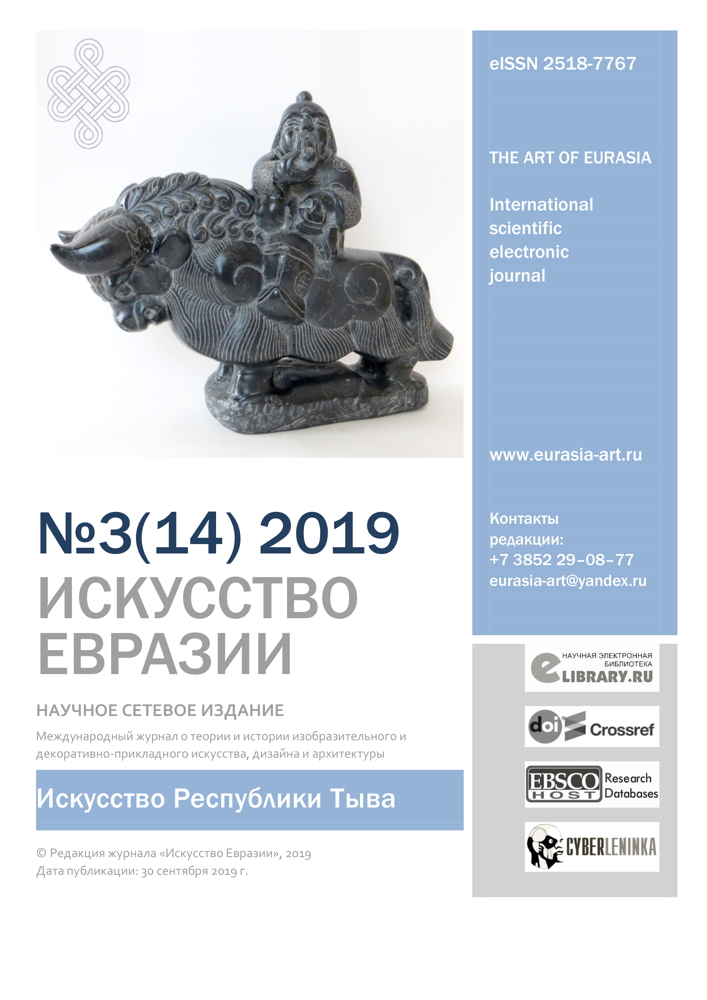
Belokurova S. M. Constants of nomadic culture in the pictures of artist Shoy Churuk // The Art of Eurasia, 2019. № 3 (14). P. 105-114. URL: https://doi.org/10.25712/ASTU.2518-7767.2019.03.007.

This work is licensed under a Creative Commons Attribution-NonCommercial 4.0 International License.
Current Issue


Information
Make a Submission
Abstract
Shoy Ulzaiovich Churuk is a famous Tuvan artist. The traditions of folk art are revived and rethought in his works. It remains important for the artist to appeal to the fundamental foundations of culture that are relevant today. This article analyzes three paintings by Sh. Churuk using the methodology of cultural universals (constants). Based on the material of the Mongolian culture, two constants are distinguished – «Warrior» and «Homeland», which seem relevant for various nomadic cultures of Eurasia.
References
- Belokurova S.M. Osnovnye napravleniya tvorchestva sovremennogo mongol'skogo khudozhnika Khainzangiin Sodnomtserena [The main directions of creativity of the modern Mongolian artist Heinzangiyn Sodnomtseren]. In: Khudozhestvennaya kul'tura Sibiri i sopredel'nykh territorii: stranitsy proshlogo i sovremennost' [Artistic culture of Siberia and neighboring territories: pages of the past and the present]. Barnaul, 2017, pp. 51-52.
- Belokurova S.M. «Zhenskaya» seriya monotipii sovremennoi mongol'skoi khudozhnitsy Zorigt Uyangi: problema interpretatsii obraza [«Women's» series of monotypes of modern Mongolian artist Zorigt Uyanga: the problem of image interpretation]. In: Kul'tura v evraziiskom prostranstve: traditsii i novatsii [Culture in the Eurasian space: traditions and innovations]. Barnaul, 2016, pp. 126-129.
- Golan A. Mif i simvol [Myth and symbol]. Moscow, Russlit, 1993. 375 p.
- Mezhregional'naya khudozhestvennaya vystavka «FORMA»: al'bom-katalog [Interregional art exhibition «FORM»: album-catalog / comp. A.V. Suslov, E.V. Chepis]. Novosibirsk, V.V. Pentyukhov, 2019. 296 p.
- Mify, legendy, predaniya tuvintsev [Myths, legends, traditions of Tuvans / Comp. ON. Alekseev, D.S. Kuular, Z.B. Samdan, J.M. Yusha]. Novosibirsk, Nauka, 2010. 372 p.
- Shishin M.Yu., Belokurova S.M., Ivanov A.V., Pervushina O.V., Tsedev N., Gantulga D. Uchenie arga bilig kak os' mongol'skoi kul'tury [The teachings of arga bilig as the axis of Mongolian culture]. Barnaul, 2013.
- Khertek A. Znakom'tes': Shoi Churuk [Meet: Shoy Churuk]. Available at: https://www.tuva.asia/news/tuva/5177-shoy.html (accesssed 22.08.2019). (In Russian).
- Tsedev N., Gekman L.P., Shishin M.Yu. Konstanty kul'tury v transgranichnoi oblasti na Altae podkhody i metody ikh obnaruzheniya [Culture constants in the cross-border area in Altai approaches and methods for their detection]. Mir nauki, kul'tury, obrazovaniya – World of science, culture, education, 2008, No. 5, PP. 160-161.
- Shishin M.Yu. Mifopoeticheskie motivy v grafike Valeriya Tebekova [Mythopoietic motifs in the graphics of Valery Tebekov]. In: Shestye iskusstvovedcheskie Snitkovskie chteniya [Sixth art criticism Snitkov readings: collection of materials]. Barnaul, Altaiskii dom pechati, 2016, pp. 69-80.
- Shishin M.Yu. Teurgiya v tvorchestve G.S. Raisheva [Theurgy in the work of G.S. Raishev]. In: Tvorchestvo G.S. Raisheva v kontekste sovremennoi kul'tury 1960–2010-e gody [Creativity of G.S. Reishev in the context of modern culture 1960–2010]. Khanty-Mansiysk, 2015, pp. 89-97.
- khudozhnikov Sibiri. Sovremennoe iskusstvo: professional'nyi spravochnik sovremennogo iskusstva Sibiri [100 artists of Siberia. Contemporary art: a professional reference book of contemporary art in Siberia]. Issue 2: 2006-2015. Novokuznetsk, Krasnoyarsk, Polikor, 2017. 437 p.
