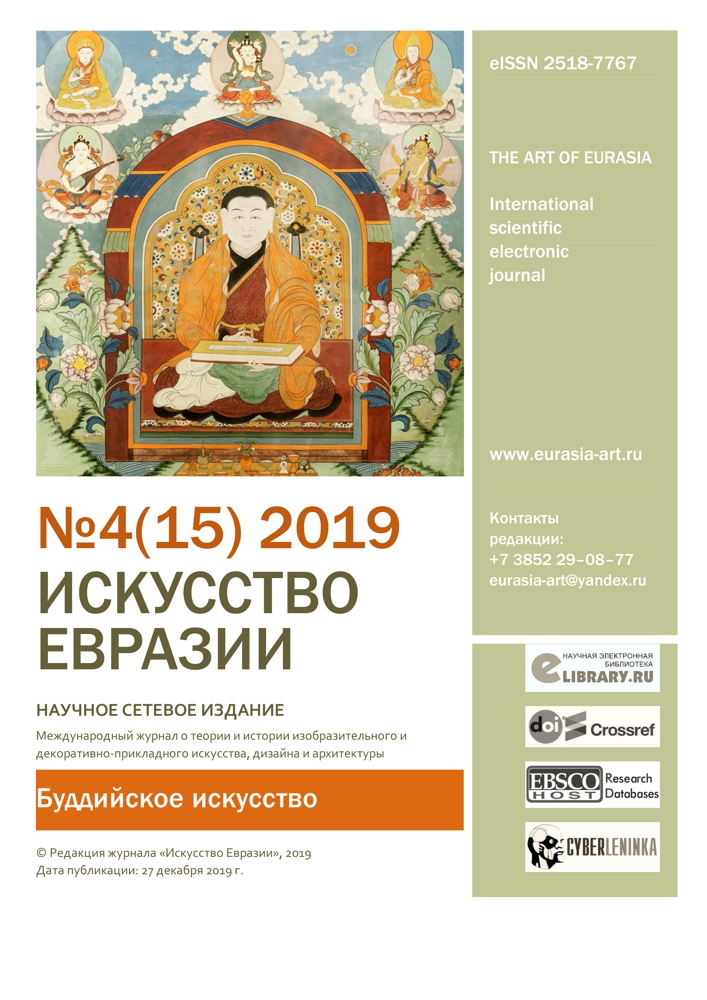
No. 4 (15) (2019): Buddhist Art



This issue № 4 (15) 2019 of “The Art of Eurasia” Journal is about Buddhist art. Russian scientist, son of academician N.K. Roerich, one of the leading orientalists of the world Yuri Roerich in his short essay "Buddhism and the cultural unity of Asia" precisely noted: “... The universal orientation of Buddhism, supported by high philosophy, has inspired philosophy, art and literature of Asian countries for centuries. Far from being reactionary, Buddhism, thanks to its influence, everywhere fostered a new type of creativity and brought the peoples of Asia face to face with the best works of the Indian mind.” This is confirmed by the collections from St. Petersburg, Yekaterinburg, Ulan-Ude, Elista, etc., which our authors tell us about.
In the “Forum” section we present a translation of an essay on Buddhist art by our regular author, Dr. O.C. Handa. His colleague P. Gupta presented an interesting view of the Buddhist icon tanka as a source of historical, ecological, religious and artistic knowledge. There are also published studies of images of Namsarai, Chakra in Buddhist art, figurative and sign system of Kalmyk costume, creativity of S. Tsybikov, Maxim Gomboev, Vladimir Vaskin. The analysis of masterpieces of Chinese bronze sculpture of the beginning of the 15th century from the collection of the State Hermitage Museum and gifts of Pandito Hambo-lamas from the collection of the Kunstkamera is also presented.
The treasures of the National Museum of the Republic of Buryatia, the National Museum of Ust-Orda Buryat Autonomous Okrug, the Ivolginsky Datsan, the Buddhist collections of the Urals are presented in the heading “In storerooms and expositions of museums and art galleries.”
Lama Ganhuugiyin Purevbat devoted his research to the traditions of depicting stupas in tanka painting, published under the heading “Philosophy and Theory of Art.”. Read here a theoretical essay on the animalistic genre in art.
In the heading “Eurasian Heritage” you will find studies about Khakassian art — national ornament in embroidery and the work of the master of woodcarving Nikolai Achitaev.
The “Art of 20th — 21st centuries” is represented this time by the names of Buryat artist Dashi-Nima Dugarov, painter and sculptor Bato Dashitsyrenov, artists Boris Ryauzov, Gennady Raishev, Semyon Chuikov.
The section “Dictionary of Buddhist Iconography by Lokesh Chandra” tells about the features of the image of Raksa.
Reviews of the anniversary personal exhibitions of Zurab Tsereteli abroad, as well as the exposition “Hunns. Empire of the Steppes” are published under the heading “Vernissage”.
Articles about exhibitions at the Russian Academy of Arts you can find in the section “Academy News”.