













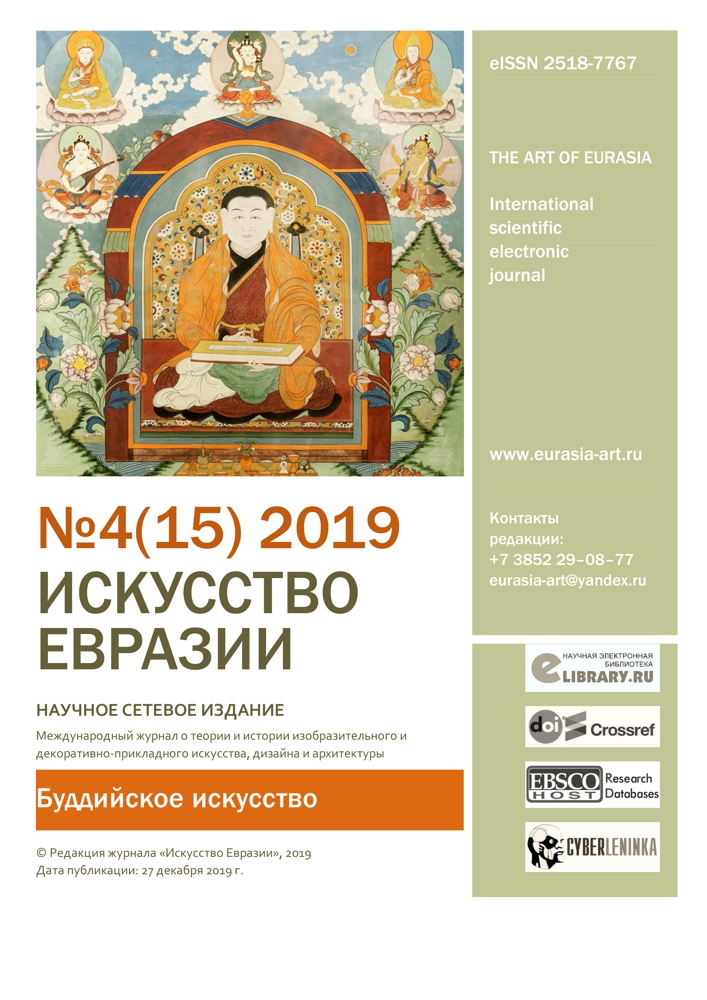
Keywords
art, Buddhism, Buddhist art, symbolism, iconography,
How to Cite
Handa O. C. Reviewing Buddhist Ecclesiastic Art // The Art of Eurasia, 2019. № 4 (15). P. 219-245. URL: https://doi.org/10.25712/ASTU.2518-7767.2019.04.015.

This work is licensed under a Creative Commons Attribution-NonCommercial 4.0 International License.
Current Issue


Information
Make a Submission
Abstract
The article analyzes Buddhist art. The specificity of Tibetan Buddhism is emphasized in comparison with the original Indian version of the Buddhist creed, which left its mark on the themes of the works, as well as on the artistic embodiment of the main ideas and motives. The pantheistic “universe” of Vajrayan Buddhism is classified, the symbolism that forms the basis of Buddhist art (symbolism of color, gestures-wise, etc.), as well as the principles of iconology, are analyzed in detail. The conclusion is made that for an adequate assessment of this art it is important to understand its intellectual essence and the significance of its symbolism, since Buddhist art is a tool to achieve a spiritual goal.
References
- Fergusson J. F. & Burgess J. Cave Temples of India,London: W. H. Allen & Co., 1880.
- Gyatsho Thubten Legshay. Gateway to the Temple. Kathmandu: Ratna Pustak Bandar, 1979.
