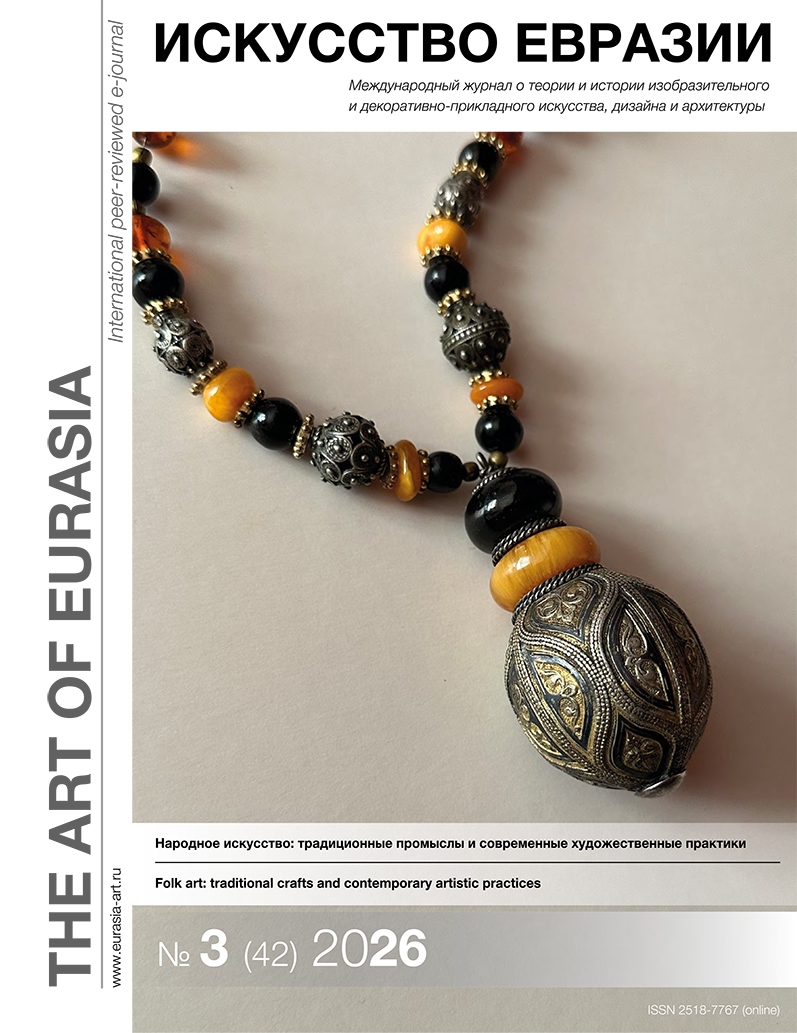
No. 3 (42) (2026): Folk art: traditional crafts and contemporary artistic practices



Issue No. 3 (42) of “The Art of Eurasia” journal is dedicated to folk art and the preservation of the national cultural code. The featured research reveals the influence of various strata of spiritual culture upon traditional arts and crafts, contemporary creative practices, and the processes of cultural heritage transmission.
The issue covers the revival of the Yamburg pottery craft of the Izhorians, the restoration of ‘Krestetskaya Strochka’ (Kresttsy embroidery) following the crisis of the 2010s, and the development of Gzhel — from its post-war renaissance to the signature works of T.S. Dunashova and E.B. Sukhorukova. An analysis of modern lacemaking systematises state support measures alongside private initiatives. Turning to the Caucasus, the publication examines the reinterpretation of Circassian (Adyghe) costume in the work of designer Madina Saralp, while Kubachi jewellery art is presented through the synthesis of traditional techniques and novel solutions by 21st-century masters such as Leila Izabakarova and the Akayev brothers.
Some publications are devoted to the interaction between folk and professional art. For instance, the ‘ornamentalism’ of M.M. Nosov is examined as a transition from folkloric thinking to academic realism in Yakutia; meanwhile, the imagery of lubok (popular prints) is traced in the theatrical sketches of Stroganov School students from the 1910s, which anticipated the avant-garde. A unique perspective is presented in the analysis of porcelain from provincial factories of the 1950s–1980s, identifying two models for adapting folk patterns within mass industrial culture. The doll in traditional costume is viewed as an important instrument of historical memory, evolving from an ethnographic replica to a complex narrative composition through the efforts of workshops in Saint Petersburg and Tver.
Of particular value is the latest material from the first half of the 2020s, including an analysis of the State Russian Museum’s exhibition “Russian Tradition” (2025–2026). The project offers a new exhibition model, introduces the concept of the ‘guardian of tradition’, and demonstrates the transformation of crafts at the turn of the 21st century. The issue convincingly proves that Russian folk art today is not a stagnant archive, but a dynamic system capable of responding to the challenges of modernity while preserving its millennial spiritual foundation.
Additionally, the issue features research on the Vetka Old Believer icon, 20th-century Siberian art, the graphic works of Vladimir Meshkov from the collection of the Altai State Art Museum, and the oeuvre of Yuri Eryshev within the context of avant-garde and Renaissance traditions. The still life genre is analysed through a compositional and semantic reading of a work by L.N. Pastushkova, alongside the evolution of the viewer’s representation — spanning from 17th-century Baroque symbolism to the phenomenology of perception in Claude Monet.