













Keywords
Rodin, «Divine Comedy» by Dante, Ghiberti, Michelangelo, Bodlaire, French sculpture of the end of XIX century,
How to Cite
Kozlova S. I. Gates of Hell: Rodin, Dante, Ghiberti and the literary nature of the plan // The Art of Eurasia, 2018. № 3 (10). P. 104-115. URL: https://doi.org/10.25712/ASTU.2518-7767.2018.03.009.

This work is licensed under a Creative Commons Attribution-NonCommercial 4.0 International License.
Current Issue


Information
Abstract
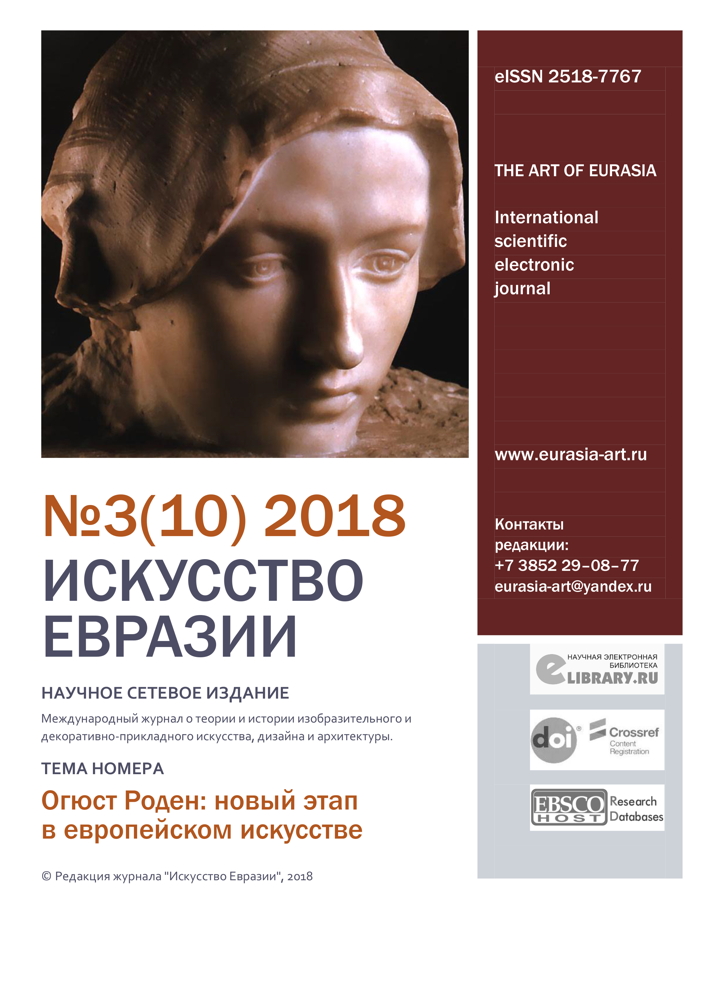
The article deals with artistic conception of Rodin’s Gates of Hell (1880–1917). The "Divine Comedy" by Dante is served the basis of interpretation of the theme, absorbed also complicated intertext – first of all there are figurative and verbal sources of the nineteenth century. Author of the article pays a principal attention to the plastical expressiveness of master’s language and to the literary aspect of his intention and concludes that this latter has played an important part to realize a general conception. Such correlation of Image and Word is evidence of beginnings of new European sculpture traits which bring the Gates of Hell together with discoveries in a sphere of psychological novel of the second half of the nineteenth century and lead to emergence of new forms of art.
References
- Rilke R.-M. Auguste Rodin. Rilke R.-M. Vorpsvede. Ogyust Roden. Pis'ma. Stikhi [Worpsvede. Auguste Rodin. Letters. Poems]. Moscow, 1971, pp. 86-134.
- Rodin A. Zaveshchanie [The Testament]. Translation from the French by V. Mikushevich. St.-Petersburg, 2002.
- Rodin A. Sbornik statei o tvorchestve [Collection of articles about creativity]. Trans. from German and French. Moscow, 1960.
- Starodubova V. Ogyust Roden. Zhizn' i tvorchestvo [Auguste Rodin. Life and art]. Moscow, 1995.
- Coquiot G. Rodin a l’Hotel de Biron et a Medon. Paris, 1917.
- Dante Alighieri. Three Lectures/ by J.C. Mathews, F. Fergusson, J. Cardi. Washington, 1965.
- Dujardin – Beaumetz E. Entretiens avec Rodin. Paris, 1913.
- Gantner R. Rodin und Michelangelo. Wien, 1953.
- Jianow J., Goldscheider C. Rodin. Paris, 1968.
- Krautheimer R. Ghiberti’s Bronze Doors. Princeton, 1971.
- Poggi G. La porta del Paradiso di Lorenzo Ghiberti. Florence, Societa Fotografie Artistiche, 1949.
