













Keywords
Tuva, cave paintings, petroglyphs, arts and crafts, barrows, deer stones, the Bronze Age, Scythian time, Aldy-Bel culture, Uyuk-Saglyn culture,
How to Cite
Kilunovskaya M. E., Semenov V. A. Art of ancient Tuva (III – I millennium BC) // The Art of Eurasia, 2019. № 3 (14). P. 20-49. URL: https://doi.org/10.25712/ASTU.2518-7767.2019.03.002.

This work is licensed under a Creative Commons Attribution-NonCommercial 4.0 International License.
Current Issue


Information
Make a Submission
Abstract
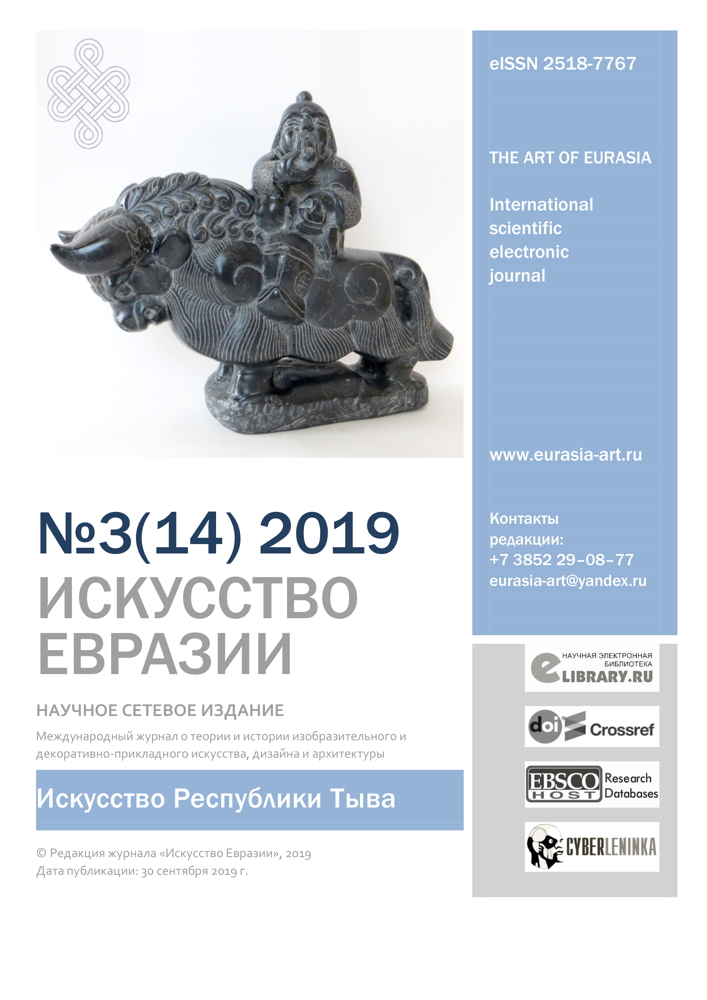
The art of ancient Tuva is represented by different types of monuments: cave paintings, deer stones and stone sculptures, objects found in settlements and burials, as well as random finds. They mainly relate to the Bronze Age, Scythian time and the Middle Ages. Chronological boundary between the 2nd and 1st millennia BC may well be called the border of eras. In the second millennium, the steppes of Central Asia represented an indiscriminate conglomerate of various tribes, in which the carriers of spiritual ideas sought to express their feelings and religious ideas in thousands of cave paintings, in which the bull often dominates as a carrier of an archaic universe that he holds or carries on his back. In the first millennium BC the picture is radically changing. Instead of scattered and disordered ideas in the world of images, a stylistic unity is being developed, which does not exclude the freedom of creativity, nevertheless the Scythian animal style becomes the main aesthetic criterion in both monumental and applied art. It extends from the Chinese wall to the Hungarian Pushta, and it is pointless to dispute its importance as a single link between the nomadic peoples of Eurasia. Even the influence of ancient civilizations cannot radically change the ideology and philosophy of the Scythian-Siberian Eurasian unity.
Acknowledgments
The study was performed according to the program of fundamental scientific researches of State academies of Sciences on the topic of state work: No. 0184-2018-0009 «Interaction of ancient cultures of Northern Eurasia and the civilizations of the East in the era of paleometal (IV Millennium BC – I Millennium BC)».
References
- Weinstein S.I. Drevnee i srednevekovoe iskusstvo Tuvy [Ancient and medieval art of Tuva]. Moscow, 1974. 224 p.
- Golan A. Mif i simvol [Myth and symbol]. Moscow, RUSSLIT, 1994. 375 p.
- Devlet E.G., Devlet M.A. Mify v kamne. Mir naskal'nogo iskusstva Rossii [Myths in stone. The world of rock art of Russia]. Moscow, Aleteya, 2005. 472 p.
- Devlet M.A. Kamennyi «kompas» v Sayanskom kan'one Eniseya [Stone «compass» in the Sayan canyon of the Yenisei]. Moscow, Nauchnyi mir, 2004.
- Devlet M.A. Petroglify Mugur-Sargola [Petroglyphs of Mugur-Sargol]. Moscow, Nauka, 1980. 272 p.
- Devlet M.A. Devlet M.A. Petroglify na dne Sayanskogo Morya (gora Aldy-Mozaga) [Petroglyphs at the bottom of the Sayan Sea (Mount Aldy-Mozaga)]. Moscow, Pamyatniki istoricheskoi mysli, 1998. 286p.
- Devlet M.A. Petroglify na kochevoi trope [Petroglyphs on a nomadic path]. Moscow, Nauka, 1982. 128 p.
- Devlet M.A. Petroglify Ulug-Khema [Petroglyphs of Ulug-Khem]. Moscow, Nauka, 1976. 120 p.
- Ivanov V.V. Byk [Bull]. In: Mify narodov mira: t.1 [Myths of the peoples of the world. Vol. 1]. Moscow, Sovetskaya entsiklopediya, 1991.
- Kenin-Lopsan M.B. Mify tuvinskikh shamanov [Myths of Tuvan shamans]. Kyzyl, 2002.
- Kilunovskaya M.E. Arzhano-maiemirskii stil' v naskal'nom iskusstve Tuvy [Arzhan-Mayemir style in the cave art of Tuva]. In: Stepi Evrazii v drevnosti i srednevekov'e [Steppes of Eurasia in antiquity and the Middle Ages. Book II]. St. Petersburg, State Hermitage Museum, 2003, pp. 52-56.
- Kilunovskaya M.E. Arkheologicheskie pamyatniki na granitse Tuvy i Mongolii (problemy kul'turnoi prinadlezhnosti i khronologii) [Archaeological sites on the border of Tuva and Mongolia (problems of cultural affiliation and chronology)]. In: Nauchnoe obozrenie Sayano-Altaya – Scientific Review of Sayano-Altai, 2018, No. 1 (21). Series: Archeology. Issue 5. Abakan, 2018, pp. 35-54.
- Kilunovskaya M.E. Byki Saamchyyra [Bulls of Saamchy?r]. In: Tropoyu tysyacheletii: K yubileyu M.A. Devlet [Millennium Path: Towards the Anniversary of MA Devlet]. Kemerovo, Kuzbassvuzizdat, 2008, pp. 124-130.
- Kilunovskaya M.E. Izobrazitel'nye pamyatniki Tuvy [Fine monuments of Tuva]. In: Homo eurasicus. U vrat iskusstva [Homo eurasicus. At the gates of art]. St. Petersburg, 2009, pp. 325-336.
- Kilunovskaya M.E. Iskusstvo skifskogo vremeni Tuvy (tipologiya, periodizatsiya i semantika) [The art of the Scythian time of Tuva (typology, periodization and semantics). Abstract of the thesis]. St. Petersburg, 1994. 18 p.
- Kilunovskaya M.E. Kolesnitsy epokhi bronzy v naskal'nom iskusstve Tuvy [Chariots of the Bronze Age in Tuva rock art]. In: Naskal'noe iskusstvo v sovremennom obshchestve k 290-letiyu nauchnogo otkrytiya Tomskoi pisanitsy. Tom 2 [Rock art in modern society on the 290th anniversary of the scientific discovery of Tomsk writings. Vol 2]. Kemerovo: KemSU, 2011, pp. 129-133.
- Kilunovskaya M.E. Monokhromnye risunki na skalakh Tsentral'noi Azii [Monochrome drawings on the rocks of Central Asia]. In: Priroda zapovednika «Ubsunurskaya kotlovina». Vyp. 2 [Nature of the Ubsunur Basin Reserve. Issue 2]. Krasnoyarsk, Darma-pechat', 2011, p. 119-134.
- Kilunovskaya M.E. Naskal'noe iskusstvo Tuvy skifskogo vremeni [Rock art of Tuva of Scythian time]. In: Kul'tury Stepnoi Evrazii i ikh vzaimodeistvie s drevnimi tsivilizatsiyami. Kniga 1 [Cultures of Steppe Eurasia and their interaction with ancient civilizations. Book 1]. St. Petersburg, Periferiya, 2012, pp. 166-172.
- Kilunovskaya M.E. Problemy datirovaniya petroglifov Tuvy (rol' sravnitel'no-tipologicheskogo metoda) [The problems of dating petroglyphs of Tuva (the role of the comparative typological method)]. In: Mezhdunarodnaya konferentsiya po pervobytnomu iskusstvu [International Conference on Primitive Art]. Kemerovo, KemSU, 1998, pp. 56-58.
- Kilunovskaya M.E. Risunki na skalakh Tuvy [Drawings on the rocks of Tuva]. In: Sbornik nauchnykh trudov v chest' 60-letiya A.V. Vinogradova [Collection of scientific papers in honor of the 60th anniversary of A.V. Vinogradov]. St. Petersburg, Kul't-Inform-Press, 2007, pp. 77-110.
- Kilunovskaya M.E. Sobranie olennykh kamnei Kyzylskogo respublikanskogo kraevedcheskogo muzeya [Collection of deer stones of the Kyzyl Republican Museum of Local Lore]. In: Problemy arkheologii, etnografii, istorii i kraevedeniya Prieniseiskogo kraya. T.1 [Problems of Archeology, Ethnography, History and Local History of the Yenisei Territory. Vol. 1]. Krasnoyarsk, 1992, pp. 136-138.
- Kilunovskaya M.E. Etapy razvitiya iskusstva skifskogo vremeni Tuvy [Stages of development of the art of the Scythian time of Tuva]. In: Trudy II Mezhdunarodnoi nauchno-prakticheskoi konferentsii «Kochevye tsivilizatsii narodov Tsentral'noi i Severnoi Azii: istoriya, sostoyanie, problemy» [Transactions of the II International Scientific and Practical Conference «Nomadic Civilizations of the Peoples of Central and North Asia: History, State, Problems»]. Krasnoyarsk & Kyzyl, 2010, pp. 131-137.
- Kilunovskaya M.E., Leus P.M. Iskusstvo kontsa pervogo tysyacheletiya do n.e. v Tuve [The art of the end of the first millennium BC in Tuva]. In: Kratkie soobshcheniya Instituta arkheologii RAN (KSIA) [Brief Communications of the Institute of Archeology of the Russian Academy of Sciences]. 2017, Issue. 247, pp. 87-104.
- Kilunovskaya M.E., Semenov Vl.A. Drevnee svyatilishche Yamaalyg [The ancient sanctuary of Yamaalyg]. In: Priroda zapovednika «Ubsunurskaya kotlovina». Vyp. 2 [Nature of the Ubsunur Basin Reserve. Issue 2]. Krasnoyarsk, Darma-pechat', 2011, pp. 135-144.
- Kilunovskaya M.E., Semenov Vl.A. Olennye kamni Tuvy [Deer stones of Tuva. Part 1]. Arkheologicheskie vesti – Archaeological News, 1998, No. 5, pp. 143-154.
- Kilunovskaya M.E., Semenov Vl.A. Olennye kamni Tuvy [Deer stones of Tuva. Part 2]. Arkheologicheskie vesti – Archaeological News, 1999, No. 6, pp. 130-145.
- Kubarev V.D., Tsaveedorzh D., Yakobson E. Petroglify Tsagaan-Salaa i Baga-Oigura (Mongol'skii Altai) [Petroglyphs of Tsagaan-Salaa and Baga-Oygur (Mongolian Altai)]. –Novosibirsk, SB RAS, 2005. 640 p.
- Semenov Vl.A. Gravirovannye gal'ki iz Tuvy [Engraved pebbles from Tuva]. In: Kamennaya skul'ptura i melkaya plastika drevnikh i srednevekovykh narodov Evrazii [Stone sculpture and small plastic of ancient and medieval peoples of Eurasia]. Barnaul, 2007, pp. 70-73.
- Semenov Vl.A. Drevneishaya migratsiya indoevropeitsev na vostok (k stoletiyu otkrytiya tokharskikh rukopisei) [The oldest migration of Indo-Europeans to the east (to the centenary of the discovery of Tochar manuscripts)]. Peterburgskii arkheologicheskii vestnik – Petersburg Archaeological Bulletin, 1993, pp. 25-30.
- Semenov Vl.A. Iskusstvo varvarskikh plemen [The art of barbarian tribes]. St. Petersburg, Chistyi list, 2015. 295 p.
- Semenov Vl.A. Elitnye pogrebeniya uyukskoi kul'tury u gory Kosh-Pei (Tuva) [Elite burials of Uyuk culture near Mount Kosh Pei (Tuva)]. In: Aktual'nye voprosy arkheologii i etnologii Tsentral'noi Azii [Actual issues of archeology and ethnology of Central Asia]. Irkutsk, 2015, pp. 178-188.
- Toporov V.N. Griby [Mushrooms]. In: Mify narodov mira. Entsiklopediya: V 2-kh t. [Myths of the World. Encyclopedia: In 2 volumes]. Moscow, Sovetskaya entsiklopediya, 1991, vol. 1, pp. 335-336.
- Chunakova O.M. Pekhleviiskii slovar' zoroastriiskikh terminov, mifologicheskikh personazhei i mifologicheskikh simvolov [Pahlavi dictionary of Zoroastrian terms, mythological characters and mythological symbols]. Moscow, Vostochnaya literatura, 2004. 286 p.
- Sher Y.A. Petroglify Srednei i Tsentral'noi Azii [Petroglyphs of Central and Central Asia]. Moscow, 1980. 328 p.

