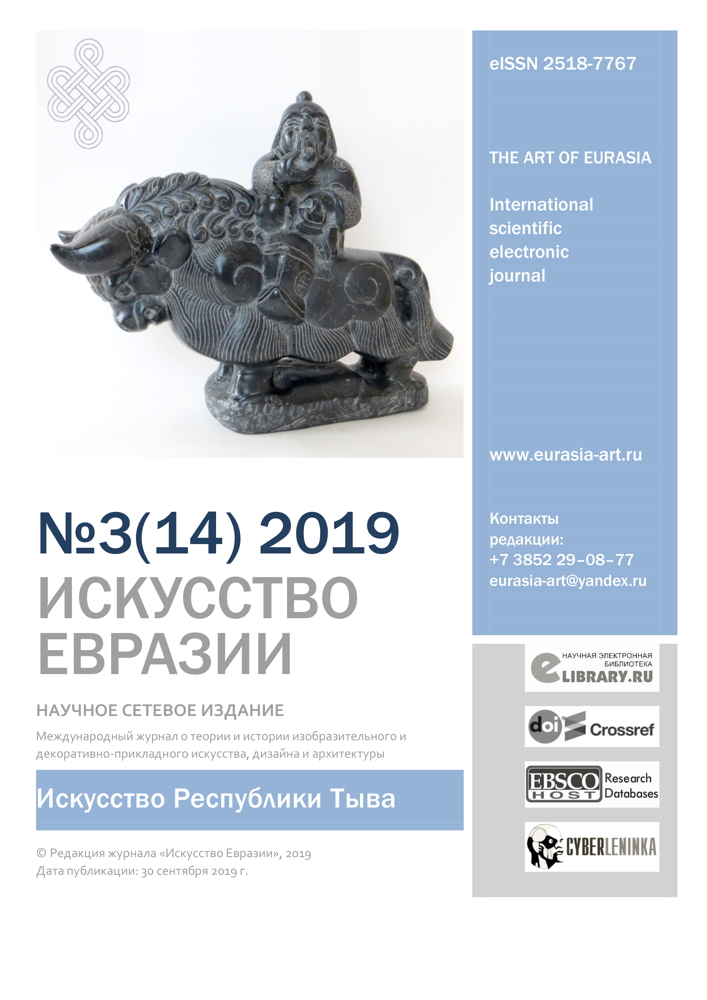
No. 3 (14) (2019): Art of the Republic of Tuva



This issue № 3 (14) 2019 of “The Art of Eurasia” Journal is dedicated to the art of Tuva — a truly holistic continuum, ancient, filled with living energies that firmly connect artists through many centuries. The studies published here represent art from the 3rd millennium BC to the beginning of the 3rd millennium of our time. At the same time, the many outstanding artists and their works of art are striking, but even more — how closely the work of the masters is interconnected for five millennia.
The “Forum” section contains articles about the traditions of Tuvan art in the works of the master Kogel Saaya, Shoy Churuk, Sergei Kochaa, Savyr Salchak, Alexander Baranmaa, and the Toibuhaa dynasty of stone cutters. You can also read about the spatial worldview, the traditional world of things and forms of Tuvan folk art here.
The topic continues in the historical context under the heading “Eurasian heritage.” It raises questions about the appearance and development of small plastics on the territory of Tuva, features of the art of ancient Tuva (3rd — 1st Millennium BC) and artistic bronze of the Hunnu period.
The rubric “In storerooms and expositions of museums and art galleries” tells about the collection of birch bark products in the National Fine Arts Museum of the Republic of Sakha (Yakutia), about Tuvan stone carving in the collection of the State Art Museum of Altai Krai and the collection of Felix Kohn. The Hermitage collection is represented here by Tuvan Buddhist art in picturesque tangkas, and the Morshansk Historical and Art Museum is represented by iconic wooden sculptures.
Reflection on the past, present and future of design is reflected in the “Philosophy and Theory of Art” column.
For an overview of the exhibition "After 1917th — Private Collection of Soviet Art of the 20th Century,” held at the Harbin Contemporary Art Museum, see the “Vernissage” section.
The section “Dictionary of Buddhist Iconography by Lokesh Chandra” tells about the features of the image of the Buddha Dipankara (Diguang).
Articles about exhibitions at the Russian Academy of Arts you can find in the section “Academy News”.