

Current Issue

Issue No. 2 (41) of “The Art of Eurasia” journal is dedicated to the art of East Asia, offering a multifaceted perspective on the interplay between form and meaning. It examines classical examples of Far Eastern art, ranging from an analysis of the role of feitian celestial beings in organising the visual space of the Tang dynasty Mogao Caves — demonstrating their evolution from a connective element into a localized focus — to a study of the architectural and spatial organisation of the Mongolian Amarbayasgalant Monastery, which reveals a unique synthesis of Mongolian, Tibetan, and Chinese traditions. Attention is also directed towards the Buddha statues of the Yungang Grottoes, identifying a synthesis of Xianbei, Indian, and Chinese traditions. Heritage preservation challenges are highlighted through the case study of the Shu Guoan house restoration in the Huizhou region, providing a detailed examination of methods used to adapt historic timber-and-stone architecture to contemporary conditions. The ideological dimension of North Korean art is explored through the oeuvre of the chosonhwa master Chong Yongman, one of the most influential figures in late twentieth-century North Korean painting. The technological factor as a stylistic foundation is addressed in an article on Tang dynasty metalware, which demonstrates that forging and embossing techniques fundamentally determined the evolution of form and decoration. Questions surrounding the development of an artist's individual style are examined through an analysis of Ike Taiga’s early landscape style, which synthesised Japanese, Chinese, and European influences, alongside a study of Chu Suiliang’s calligraphy, tracing its evolution from the imitation of Ouyang Xun to an independent, fluid manner. Finally, the work of contemporary Russian artists T. Badanina and V. Nasedkin, showcased at Japanese art festivals, demonstrates a profound ethical and philosophical resonance with Japanese tradition, rooted not in superficial imitation but in an intrinsic affinity of principles.
The issue also features research spanning a broad spectrum of art-historical problems. It examines the distinctive characteristics of the Vetka iconography of “Archangel Michael the Voivode”, the creative heritage of the Tuvan carver Dongak Okaanchyk, and the history behind the establishment of the Polygraphic Arts Section of the RAKhN (Russian Academy of Artistic Sciences). Several articles focus on Soviet art, analysing the Leningrad school of lithography through the prism of the 1961 London exhibition, alongside the mechanisms that transformed artistic activity in 1933 based on archival materials from Leningrad and Irkutsk. The issue further includes papers on Western art, exploring mythical geography in the actionism of Joseph Beuys, and contemporary Russian painting, addressing the conceptualisation of “Russianness” in the work of Grigory Gukasov. Finally, theoretical reflections delve into prehistoric art within the context of Mikhail Lifshitz's and György Lukács's ideas, the evolution of the terms “caricature” and “portrait caricature” in the encyclopaedic tradition, and the nature of creativity regarding mass culture products generated by artificial intelligence (AI).
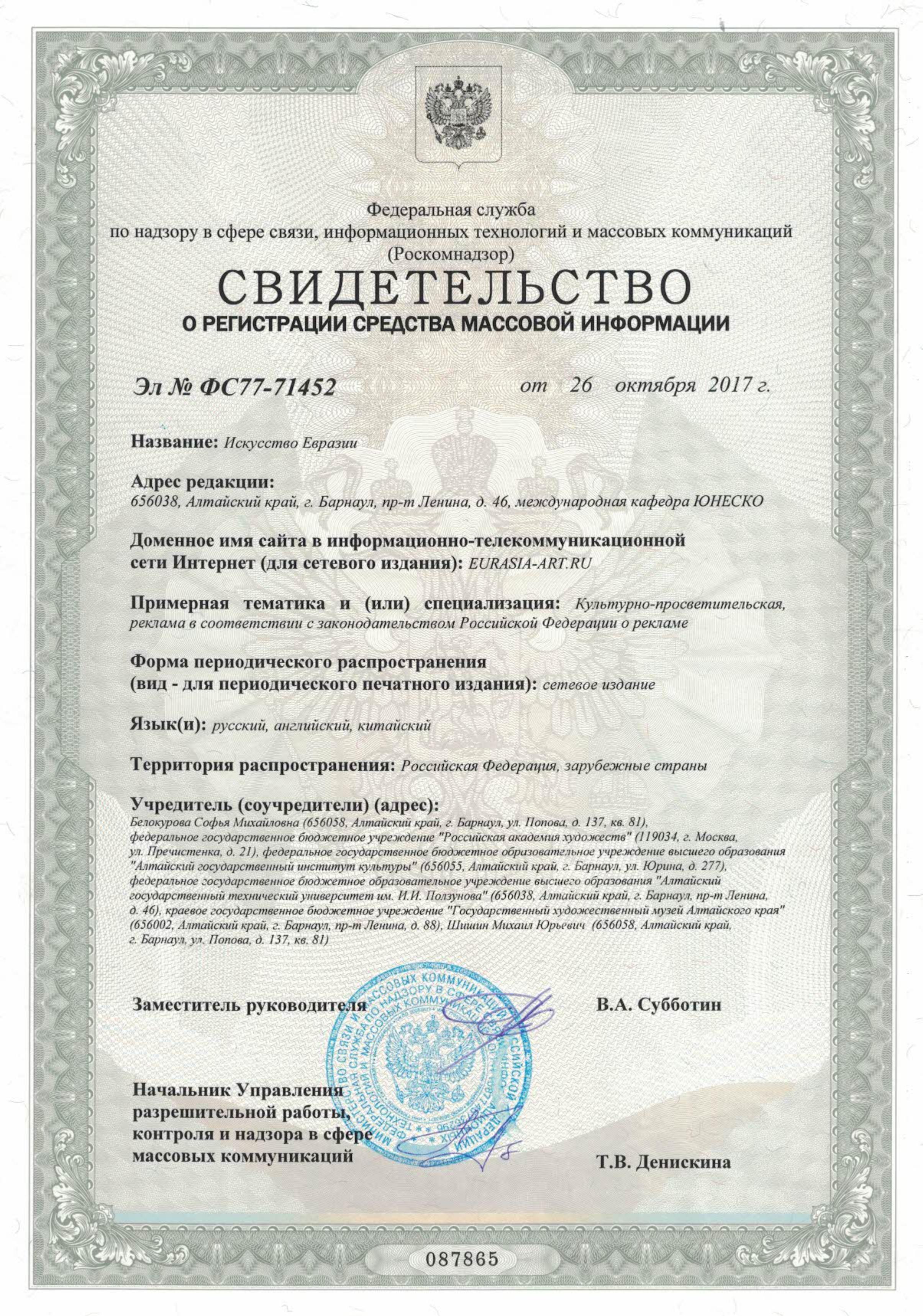
“The Art of Eurasia” ("Iskusstvo Evrazii", ISSN 2518-7767 Online) is an international peer-reviewed academic journal on the theory and history of fine and decorative arts, design and architecture. The journal was founded with the participation of the Russian Academy of Arts, and has been published since 2015 four times a year (March, June, September, December) in electronic form according to the open access model. It is distributed in Russia, CIS countries, and abroad. The journal publishes scientific articles, analytical reviews of exhibitions, specialized competitions and forums, the results of theoretical and applied research, materials of a scientific and educational nature, corresponding to the journal's topics: theory and history of art, architecture, design.
All Journal submissions are peer-reviewed and edited by leading researchers.
The original Russian edition The Art of Eurasia Journal is distributed by the Scientific Electronic Library (www.elibrary.ru) and is included in the Russian Science Citation Index (RSCI).
There are Russian and foreign noted researchers in the Editorial Board and among the Journal authors.
No publication fees or payments are charged from the Journal authors.
Indexing