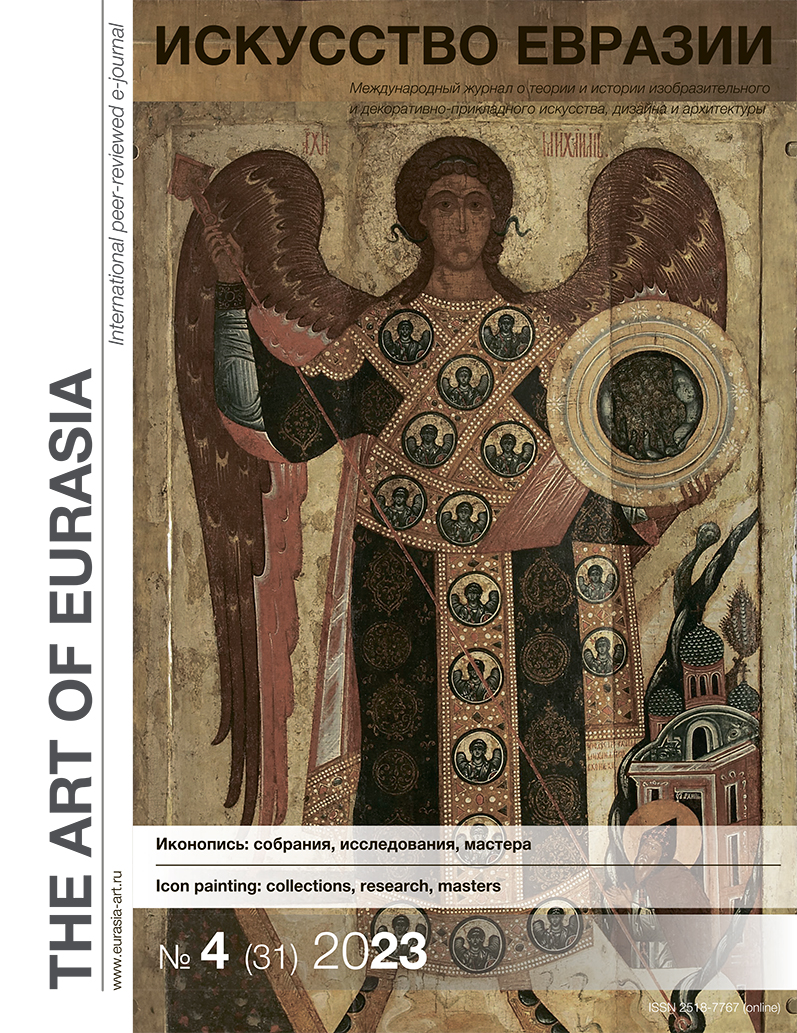
Icon painters of Tobolsk province of the 17th – early 20th century
Выпуск № 4 (31) 2023 журнала "Искусство Евразии"
HTML (Russian)
PDF (Russian)
JATS XML (Russian)
HTML (Russian)
PDF (Russian)
JATS XML (Russian)

Keywords

icon, icon painters, icon painting workshops, Tobolsk province, icon painting of the 17th – early 20th century

Categories

Creative Commons License

This work is licensed under a Creative Commons Attribution-NonCommercial 4.0 International License.

How to Cite

Sukhorukova, N.V. (2023) ‘Icon painters of Tobolsk province of the 17th – early 20th century’, The Art of Eurasia, (4), pp. 146–155. doi:10.46748/ARTEURAS.2023.04.008.

Индексация статей

Белый списокScience IndexDimensionsDOAJOpenAlexScilitКиберЛенинкаEBSCOCrossrefDataCiteInternet Archive ScholarGoogle Scholar
Open Access
Антиплагиат

* Not an advertisement

Abstract

The aim of this study is to provide a systematic overview of the historical aspects of icon painting in Tobolsk province during the 17th to early 20th century. By using the source study method, a multitude of archival materials from the Tobolsk Ecclesiastical Consistory and the Tobolsk provincial magistrate were identified. The study enabled the identification of numerous Tobolsk icon painters and their orders, to trace the introduction of cultural influences from various spiritual and artistic centres of Russia into the local territory, and to draw conclusions about the local artistic features that developed in the spiritual centre of Siberia.

The hypothesis suggests that alterations in the spiritual and social paradigm correlated with changes in the development and style of icon painting in Siberia during each stage. If during the 17th century, the primary approach to icon painting was based on Orthodox traditions, mainly from Veliky Novgorod and Solvychegodsk centres, then at the start of the 18th century, the Baroque style was introduced, which was associated with the orders of the supreme bishops of Siberia, graduates of the Kiev Theological Academy. The theatrical and decorative style corresponded to the rise of development and civilizational transformation in Siberia. The 19th-century academic style aligned with the imperial spirit's regulation and balance. The second half of the 19th century saw a spiritual and religious upsurge, causing a return to the tradition of painting saints' faces in the Old Russian style.

The formation and development of Siberian icon painting were influenced by various factors. These factors included the influx of icon painters from the inner circle of the Tobolsk spiritual hierarchs, who made efforts to create systematic training in icon painting; the presence of professional artists among the exiles who struggled for survival and adaptation in harsh conditions; and the selfless devotion of women, which manifested itself in the development of artistic crafts.

DOI: https://doi.org/10.46748/ARTEURAS.2023.04.008

References

  1. Kopylov, A.N. (1974) Essays on the cultural life of Siberia in the 17th and early 19th centuries. Novosibirsk: Nauka. (In Russ.)
  2. Baidin, V.I., Golynets, S.V., Zolnikova, N.D., Ovchinnikova, B.B. and Fedorov, S.V. (eds.) (1999) Siberian icon. Omsk: Irtysh-92 Publ. (In Russ.)
  3. (Anon.) (n.d.) ‘1710: Tobolsk district: census book of the city of Tobolsk, census of Prince Vasily Meshchersky’, in Russian State Archive of Ancient Acts (RGADA), coll. 214, aids 1, fol. 1314. p. 755. (In Russ.)
  4. State Archive in Tobolsk, coll. 156, aids 1, fol. 305, p. 182. (In Russ.)
  5. State Archive in Tobolsk, coll. 156, aids 4, fol. 617, p. 1–46. (In Russ.)
  6. State Archive in Tobolsk, coll. 156, aids. 3, fol. 2658, p. 58. (In Russ.)
  7. State Archive in Tobolsk, coll. 156, aids 2, fol. 2716, pp. 1–2. (In Russ.)
  8. Bezhan, E.M. (2013) ‘Berezovsky icons in the collection of the Omsk State History and Local Lore Museum’, Izvestiya Omskogo gosudarstvennogo istoriko-krayevedcheskogo muzeya = News of the Omsk State Museum of History and Local Lore, (18), pp. 252–261. (In Russ.)
  9. State Archive in Tobolsk, coll. 70, aids 1, fol. 10, pp. 49–49 back. (In Russ.)
  10. State Archive in Tobolsk, coll. 57, aids 1, fol. 8, pp. 1–4. (In Russ.)
  11. State Archive in Tobolsk, coll. 156, aids 2, fol. 286, p. 1–2. (In Russ.)
  12. State Archive in Tobolsk, coll. 156, aids 3, fol. 2410, p. 1. (In Russ.)
  13. State Archive in Tobolsk, coll. 156, aids 4, fol. 53, p. 1. (In Russ.)
  14. State Archive in Tobolsk, coll. I-8, aids 1, fol. 1, pp. 1–8. (In Russ.)
  15. State Archive in Tobolsk, coll. 156, aids 2, fol. 504, pp. 1–2. (In Russ.)
  16. State Archive in Tobolsk, coll. 156, aids 4, fol. 821, pp. 1–2. (In Russ.)
  17. State Archive in Tobolsk, coll. 156, aids 6, fol. 200, pp. 1–3. (In Russ.)
  18. State Archive in Tobolsk, coll. 156, aids 31, fol. 668, pp. 21–21 back. (In Russ.)
  19. State Archive in Tobolsk, coll. 57, aids 1, fol. 38, pp. 1–23. (In Russ.)
  20. State Archive in Tobolsk, coll. 197, aids 1, fol. 96, pp. 1–63. (In Russ.)
  21. State Archive in Tobolsk, coll. 197, aids 1, fol. 102, pp. 73. (In Russ.)