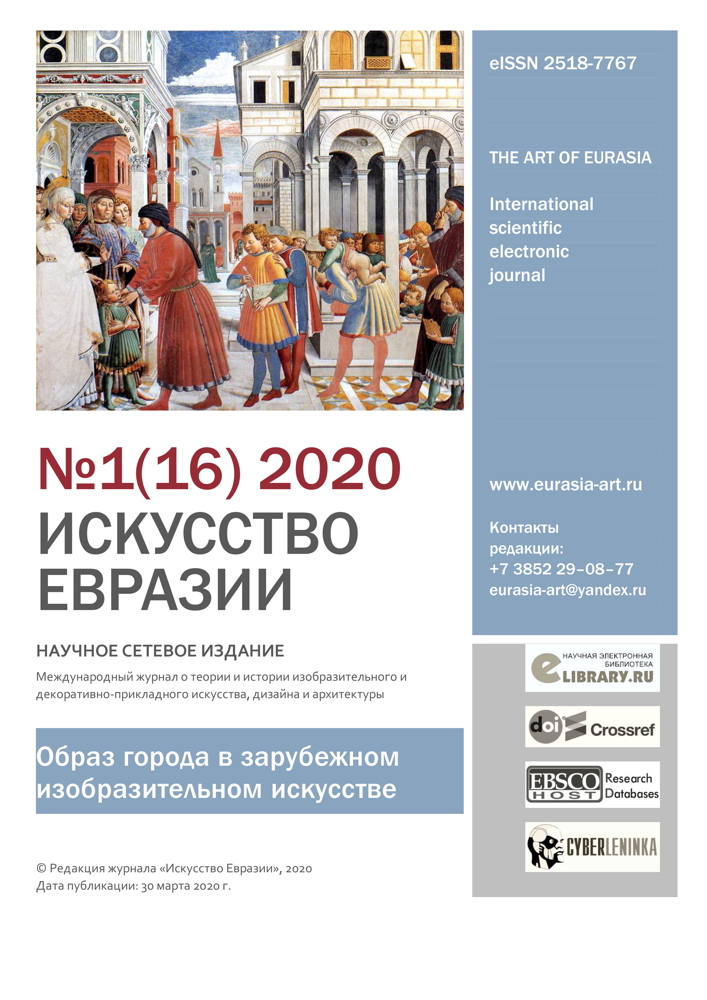
No. 1(16) (2020): The Image of the City in Foreign Fine Arts

The Image of the City in Foreign Fine Arts

This issue № 1 (16) 2020 of “The Art of Eurasia” Journal is about the image of the city in art. In the central heading “Forum”, this topic is revealed most fully. Here we began to consider it with articles that analyze the heritage of the countries of the East and Western Europe. And in the next issue of our Journal you will find no less interesting and deep articles about Russian art.

Articles on the topic of the city are also published in the section “Art of the 20th — 21st centuries”, which shows how differently, but always very interesting, the city is reflected in monumental art, light kinetics, street art, exhibition art projects in the urban environment.

The heading “Philosophy and Theory of Art” tells about the influence of lighting and subsequent media on the formation of images of urban space.

Traditions and images, their ancient origins and contemporary embodiment are explored in the heading “Eurasian Heritage.” Analyses of the image of the wolf of the Hunnu period and ethnographic images of Khakas in the works of Vasily Surikov are published here.

Maya (Mayadevi, Mahamaya) and features of its image are the focus of an article from the “Dictionary of Buddhist Iconography by Lokesh Chandra” in this issue.

Articles about exhibitions at the Russian Academy of Arts you can find in the section “Academy News”.
Read the entire issue in HTML >

Full Issue
PDF (Russian)

Eurasian Heritage

Anna Ilyinichna Pankina, Lyudmila Valentinovna Lbova, Larisa Gennadevna Yaroslavtseva
The wolf engraved image on a horn pendant of the Hunnic time (burial ground Cheremukhovaya pad, Transbaikalia)
10–22
PDF (Russian)
Maina Petrovna Chebodaeva
Ethnographic images of Khakases in the work of V.I. Surikov
23–44
PDF (Russian)

Dictionary of Buddhist Iconography by Lokesh Chandra

Lokesh Chandra
Maya, Mayadevi, Mahamaya
45–48
PDF (Russian)

Forum

Olga Evgenievna Etinhof
The image of a city in the mosaics of the Basilica of the Nativity in Bethlehem
50–65
PDF (Russian)
Svetlana Izrailevna Kozlova
The Quattrocento city: between reality and ideality
66–76
PDF (Russian)
Ekaterina Ivanovna Tarakanova
The Image of the city in Italian chapels of the 15th century (a study of Benozzo Gozzoli’s fresco cycles)
77–91
PDF (Russian)
Marina Georgievna Piven
Images of Troy and Carthage in Quatrocento Italian book miniatures and decorative painting
92–104
PDF (Russian)
Oxana Sergeevna Smagol
The scenery of Ercole I d’Este Ferrara in a woodcut from Modena Estense Library and a problem of Renaissance in Lombardy and Venice
105–117
PDF (Russian)
Nadezhda Mikhailovna Sim
Baeza and Ubeda – the first cities of Spanish Renaissance
118–133
PDF (Russian)
Aleksander Florentinovich Esono
Topographic views in German broadsheets of the 17th century: “Portrait of the city” and the verisimilitude of Baroque
134–145
PDF (Russian)
Tatiana Khamzyanovna Starodub
City image in illustrations of Arabic manuscripts of the XII–XIV centuries
146–161
PDF (Russian)
Marian Turek
Images of a city and its people in the work of the artist Daniel Chodowiecki (1726–1801)
162–173
PDF (Russian)
Marina Aleksandrovna Neglinskaya
“Chinese Style” in architecture and planning of London (1811–1820)
174–184
PDF (Russian)
Tatyana Kirillovna Mikhalkova
Helsinki parks and squares as the city dominant
185–195
PDF (Russian)
Anastasia Yuryevna Koroleva
On the crossroad of avant-garde: Ernst Ludwig Kirchner and his painting “Potsdamer Platz”
196–211
PDF (Russian)
Maria Andreevna Belikova
The image of Berlin in the works of “New objectivity” artists of the 1920-s
212–226
PDF (Russian)
Olga Nikolaevna Filippova
The theme of the city in the creative work of Vasily Kandinsky
227–238
PDF (Russian)
Natalia Mikhailovna Goncharenko
City in Italian art of the first half of the 20th century: not only futurism
239–261
PDF (Russian)

Philosophy and Theory of Art

Ольга Игоревна Томсон
In the media performance space
262–269
PDF (Russian)
Elena Dmitrievna Fedotova
Nikolay Gogol about Rome and the Roman Carnival
270–276
PDF (Russian)