No. 2 (9) (2018): Installation: the Classic Origins and Future

Installation: the Classic Origins and Future

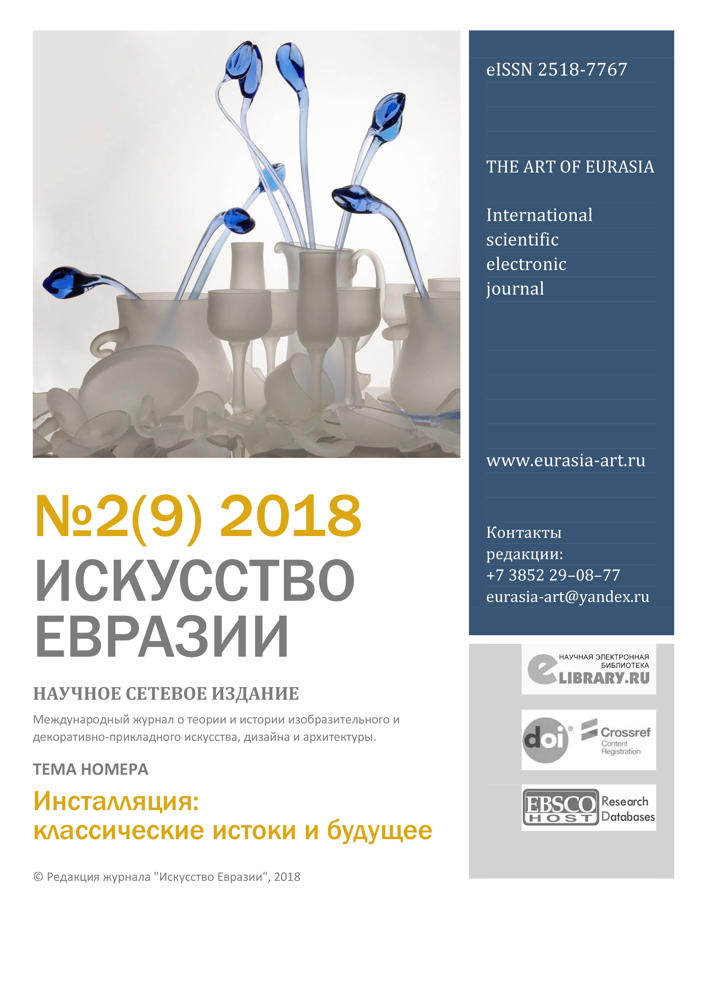
Issue № 2 (9) 2018 of “The Art of Eurasia” Journal is about installation questions. There is a lot of discussion about this form of artistic creation, and readers will be able to get acquainted with different opinions. Here, in the articles of art historians, the installation is considered as a phenomenon of modern art, as an object of creativity in design and architecture. From the origins in the spectacular culture of the Italian Renaissance and Chinese art and the first proto-installations — to examples of contemporary art in Russia and abroad.

The section “Eurasian heritage” tells about the archaic art of Eurasia. The figurative system of petroglyphic compositions and the symbolic interactionism of the Malta anthropomorphic Paleolithic sculpture are analyzed here.

The section “Art of the 20th — 21st centuries” contains articles about the Far Eastern artist Ivan Dunkai and the famous master Mstislav Dobuzhinsky.

Acquaintance with the collection of Western European art in Yakutsk, the brightest works of artists from Italy, France and other countries, is presented in the section “In the storerooms and expositions of museums and art galleries.”

In the heading “Philosophy and Theory of Art” we gave the floor to J.-W. von Goethe, who was not only a genius writer, but also an interesting art theorist. The ideas of his short article on fine art issues are still relevant today.

Vyadipada and his canons of depiction continue a series of publications in the “Dictionary of Buddhist Iconography by Lokesh Chandra”.

Articles about exhibitions at the Russian Academy of Arts you can find in the section “Academy News”.
Read the entire issue in HTML >

Full Issue
PDF (Russian)

Dictionary of Buddhist Iconography by Lokesh Chandra

Lokesh Chandra
Vyadipada
73-74
PDF (Russian)

Forum

Elena Dmitrievna Fedotova
On installation as a phenomenon of contemporary art
75-77
PDF (Russian)
Vladimir Ruvimovich Aronov
Art installation as an object of creativity in design
78-87
PDF (Russian)
Rimma Mikhailovna Bayburova
Deconstructivism as an architectural installation
88-97
PDF (Russian)
Pavel Vladimirovich Voinitski, Elena Mikhailovna Zlatkovic
Art installation from glass and steel with elements of museum collection for exposition of State literary museum of Yanka Kupala
98-104
PDF (Russian)
Elena Mikhailovna Zlatkovic
Glass installation as a form of thinking in Belarusian art of the end of 20th – the beginning of the 21st centuries
105-112
PDF (Russian)
Elena Vladimirovna Igumnova
Young British Artists and installation experience
113-123
PDF (Russian)
Lyudmila Vasilyevna Kazakova
Landscape glass as a form of dialogue with space
124-134
PDF (Russian)
Svetlana Israelevna Kozlova
Installation before installation. Two examples of renaissance spectacular culture
134-144
PDF (Russian)
Anastasia Yuryevna Koroleva
"Fire tower" of Johannes Itten: plastic studies or protoinstallation
145-153
PDF (Russian)
Galina Gennadievna Mazheykina
Installations of the XXI century – from the conception to the implementation of contemporary art examples in Russia and the CIS
154-163
PDF (Russian)
Marina Alexandrovna Neglinskaya
Installation in Chinese art: the origins of tradition
164-169
PDF (Russian)
Irina Yuryevna Perfilyeva
Installation core in art jewelry the second half of XX – beginning of XXI centuries
170-179
PDF (Russian)
Tatyana Khamzyanovna Starodub
Holiday parades in Ottoman miniature of the XVI–XVIII centuries
180-192
PDF (Russian)
Elena Dmitrievna Fedotova
The "Altar of Good Fortune" by I. Goethe: autonomous form in a park space
193-198
PDF (Russian)
Olga Evgenievna Etinhof
Relief decoration of the church facades of the Byzantine world
199-211
PDF (Russian)
Olga Alexandrovna Yartseva
Robert Raushenberg: from "combine painting" to installation
212-220
PDF (Russian)