Abstract
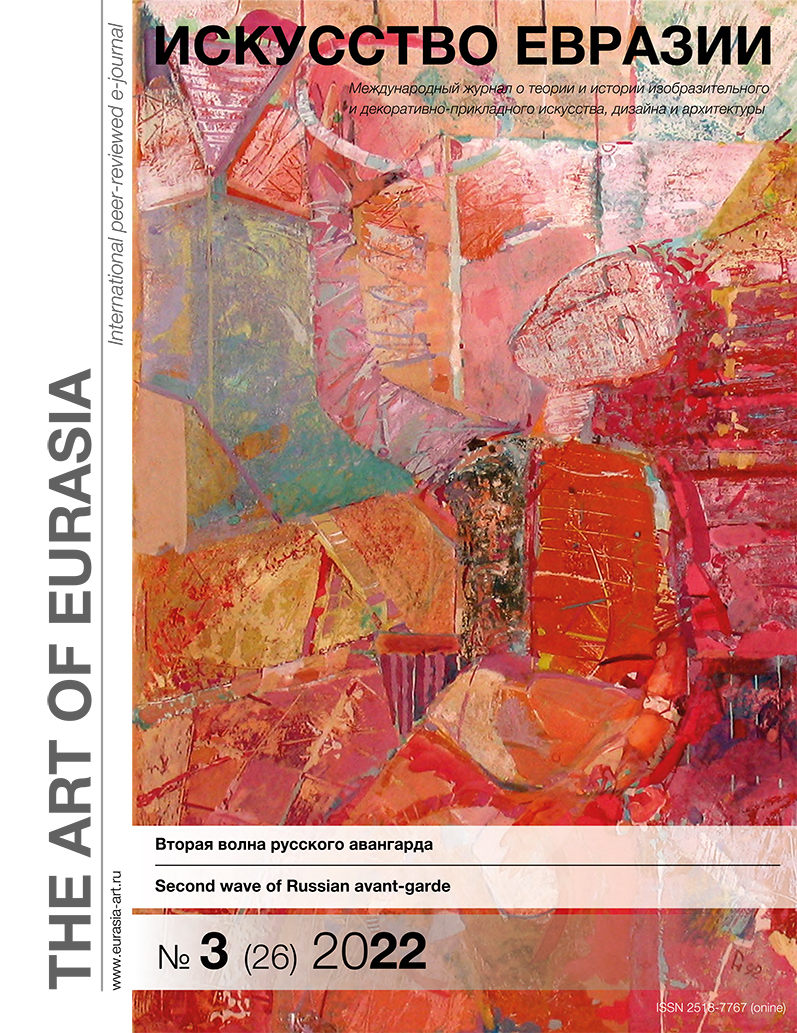
The article examines the process of formation of grotesque imagery in the work of the Novosibirsk artist N.D. Gritsiuk (1922–1976) on the example of the transformation of the motif of ancient Russian architecture in the series “Fantasies and interpretationsˮ. The source of the grotesque compositions are scribbles from the artist’s travel albums, created on the principle of automatic writing from fragments of ancient Russian architecture, silhouettes of a Dymkovo toy and parts of the human body. In the process of creative searches, these combined grotesques organically transform into independent carnival compositions, reflecting the author has detached ironic attitude to folklore motifs and plots. In the compositions of the turn of the 1960s and 1970s, while maintaining the grotesque imagery, irony is replaced by an alarming intonation of uncertainty. Placed in a restless, colour saturated space, the temples turn into deformed and disjointed anthropomorphic hybrid images, which reflect the existential experiences of the artist. Reality becomes ambiguous and unsteady for Gritsiuk, and he considers it from the angle of absurdity and phantasmagorical assumptions. The emergence of a tragic pandemonium, associatively read by the viewer as a symbol of the doomsday, testifies to the artist's reflections on the manifestations of the spiritual, the transcendent. The spiritual and at the same time absurdist problematic of hybrid images brings Gritsiukʼs search, on the one hand, to the metaphysical painting of M.M. Shvartsman and E.A. Steinberg, and on the other hand, to the grotesque art of the sculptors E.I. Neizvestny and V.A. Sidur. Thus, in the conditions of the dominant realistic discourse, the grotesque as a technique allowed the Novosibirsk artist to immerse himself in the symbolic space of free self-expression and come into contact with the world of the transcendent.
References
- Manin, V.S. (1987) ‘Phantasmagoria’, in Gritsiuk, V.E. (comp.) Nikolay Gritsiuk. Man and artist, pp. 29–49. Novosibirsk: Novosibirskoe knizhnoe izdatelʼstvo. (In Russ.)
- Muratov, P.D. (1987) ‘Creation’, in Gritsiuk, V.E. (comp.) Nikolay Gritsiuk. Man and artist, pp. 3–28. Novosibirsk: Novosibirskoe knizhnoe izdatelʼstvo. (In Russ.)
- Anon. (2007–2010) Nikolay Gritsiuk [Catalog in 22 vols.], vol. 11–16. Novosibirsk: s.n. (In Russ.)
- Vasari, G. (1993). Lives of the most famous painters, sculptors and architects, (in 5 vols.), vol. 1. Moscow: Terra. (In Russ.)
- Efimova, E.A. (2012) ‘Grotesques: to the history of one motif of the Mediterranean decorative tradition’, Vestnik Nizhegorodskogo universiteta im. N. I. Lobachevskogo = Vestnik of Lobachevsky University of Nizhni Novgorod, (6–3), pp. 249–255. (In Russ.)
- Manin, V.S. (2015) ‘Nikolay Gritsiuk’, in Gritsiuk, T. and Gritsiuk, A. (comps) Gritsiuk [Album], pp. 6–29. Novosibirsk: s.n. (In Russ.)
- Manin, V.S. (1973) Nikolay Gritsiuk. Moscow: Sovetskiy khudozhnik. (In Russ.)
- Svetlyakov, K.A. (2020) ‘The culture of the era of stagnation and the problems of postmodernism’, in Adaskina, N., Alymov, S., Borovsky, A., at al. Itʼs been forever. 1968–1985, pp. 12–17. Moscow: Tretyakov Gallery. (In Russ.)
- Yakovleva, A.M. (2001) ‘Kitsch and parakich: the birth of art from the prose of life’, in Zorkaya, N.M. (ed.) The artistic life of Russia in the 1970s as a systematic whole, pp. 252–263. Saint Petersburg: Aleteyya. (In Russ.)
- Andreeva, E.Yu. (2012). The angle of mismatch. The schools of non-conformism. Moscow – Leningrad. 1946–1991. Moscow: Iskusstvo – 21 vek Publ.. (In Russ.)
- Florkovskaya, A.K. (2020). ‘Religious, metaphysical, irrational in the unofficial Soviet art of the era of stagnation’, in Adaskina, N., Alymov, S., Borovsky, A., at al. Itʼs been forever. 1968–1985, pp. 32–37. Moscow: Tretyakov Gallery. (In Russ.)
- Chimitov, V.N. (2021). ‘Nikolai Gritsyuk and generation of war veterans: to the question of the reasons for forming nonconformist trends in the creativity of the artist’, in Trigaleva, N.V. (ed.) Glory to the winners! [Conference proceedings], pp. 55–60. Krasnoyarsk: Polikor. (In Russ.)
- Aimermacher, K. (2004) ‘Ernst Neizvestny as an artist and a rebel: Art as a provocation and vocation’, in Aimermacher, K. From unity to diversity: inquiries into the “otherˮ art of the 1950s – 1980s, pp. 189–196. Moscow: Russian State University for the Humanities. (In Russ.)