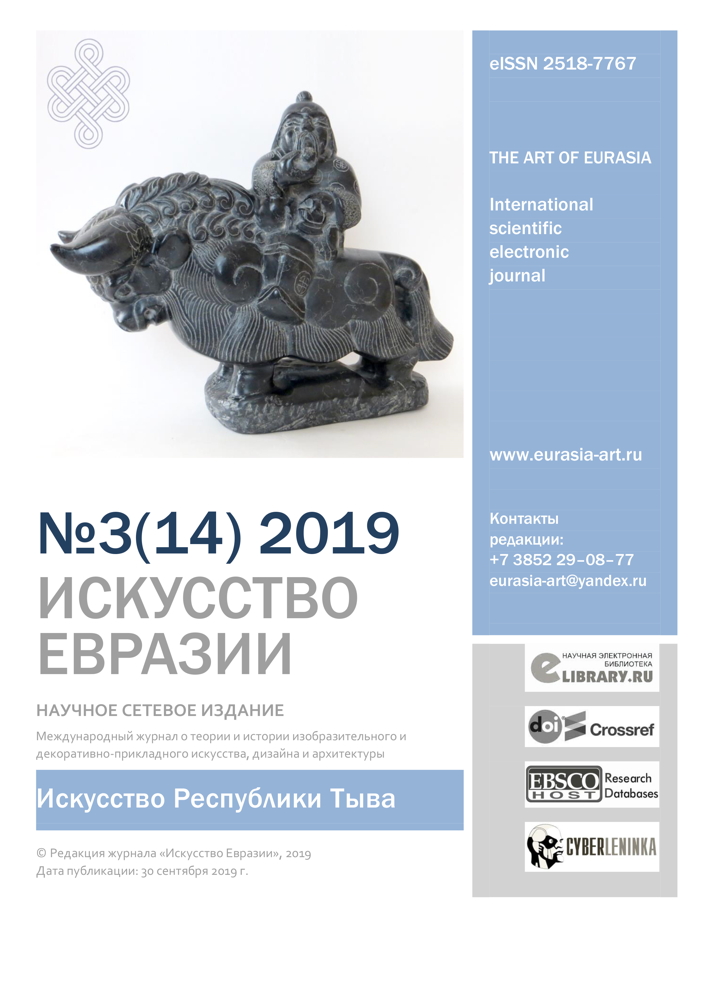
The traditional world of things of the Tuvinian nomads: УДК745/749
№ 3 (14) 2019 "Искусство Евразии", научный журнал об искусстве.
PDF (Russian)
PDF (Russian)

Keywords

nomadic culture, Tuvans, arts and crafts, utensils, tradition, utilitarian, spiritual needs of the nomad

Categories

Creative Commons License

This work is licensed under a Creative Commons Attribution-NonCommercial 4.0 International License.

How to Cite

Budegechieva, T.B. (2019) ‘The traditional world of things of the Tuvinian nomads: УДК745/749’, The Art of Eurasia, (3), pp. 115–129. doi:10.25712/ASTU.2518-7767.2019.03.008.

Индексация статей

Белый списокScience IndexDimensionsDOAJOpenAlexScilitКиберЛенинкаEBSCOCrossrefDataCiteInternet Archive ScholarGoogle Scholar
Open Access
Антиплагиат

* Not an advertisement

Abstract

This article is about the man-made, household items habitat of Tuvinians, whose culture was formed in the course of nomadic way of life since ancient times. They raised the question of the existing distinctive ethno-cultural complex, in the structure of which applied crafts played a significant role. At the same time, the archaeological, ethnographic format of the research was mainly focused on the description of material objects, artifacts, their functional purpose, the procurement of certain materials, their processing, decoration techniques, tools used, etc. In this article, the author pays more attention to the so-called “hidden” layers in the manufacture of household items. It means that each subject included a complex content, which, along with its functional purpose, included worldview, social, aesthetic, moral, environmental and other components. Attention to spiritual, value meanings is explained by the position of the author, which consists in the fact that the objective world grows out of the sphere of consciousness of the people, and the creation of reality takes place in the depths of human life. Without this, the modern generation cannot fully “read” the cultural code of their ancestors, understand the importance of traditional heritage, its role in preserving the identity of the people.

DOI: https://doi.org/10.25712/ASTU.2518-7767.2019.03.008

References

  1. Weinstein S.I. Istoriya narodnogo iskusstva Tuvy [History of folk art of Tuva]. Moscow, Science, 1974.
  2. Kon F.Ya. Za pyat'desyat let. Sobranie sochinenii. T. 3. Ekspeditsiya v Soiotiyu [For fifty years. Collected works. Vol. 3. Expedition to Soyotia]. Moscow, 1934.
  3. Mannay-Ool M.H. Tuva v skifskoe vremya (uyukskaya kul'tura) [Tuva in the Scythian Period (Uyuk culture)]. Moscow, Nauka, 1970.
  4. Field materials of the author.
  5. Tsultem N.-O. Iskusstvo Mongolii s drevneyshikh vremen do nachala XX veka [Art of Mongolia from ancient times till beginning of the 20th century]. Moscow, Izobrazitel’noe iskusstvo, 1984.
  6. Chugunov K.V., Partzinger G., Nagler A. Zolotye zveri iz doliny tsarei [Golden animals from the King Valley]. St.-Petersburg, Hermitage, 2004.
  7. Spengler O. Zakat Evropy. Т. 2 [Sunset of Europe. Vol. 2]. In: Kul'turologiya. XX vek. Ontologiya [Culturology. XX century. Ontology]. Moscow, 1995, pp. 432-453.