Abstract
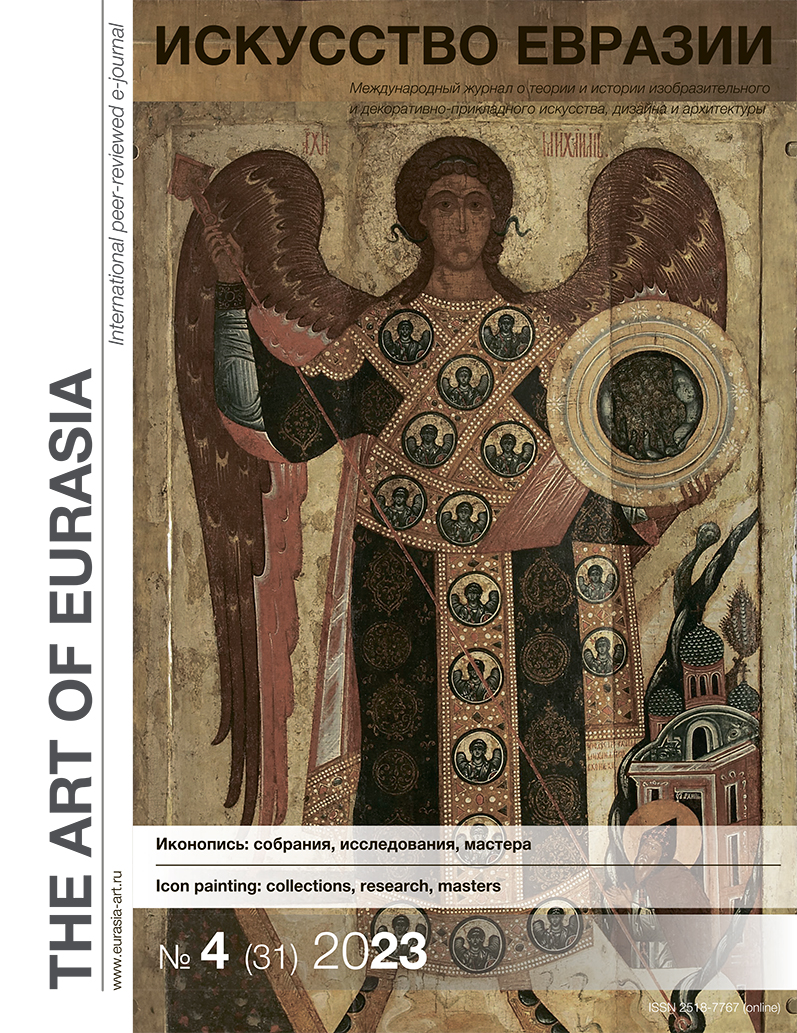
The collection of icon painting came to the State Art Museum of Ugra in 2011 from the collection of the Art Gallery of the Generations Foundation. Most of the items have been very little studied, as they were in private collections for many years and practically never published. The purpose of this article is to introduce a number of works into the scientific turnover, which will enable us to study them in the context of the development of icon painting in Russia in the period from the sixteenth to the nineteenth centuries. Although the iconography of the Ural-Siberian region is not represented here, the collection gives an opportunity to get acquainted with the iconography of the Volga region and the Russian North, with the iconographic schools of Yaroslavl, Novgorod, Mstyora, Rostov, Vologda and others. The article includes a description and analysis of the iconography and stylistic features of the works; a number of items are of special interest. The material is structured in several blocks: icons and iconography of the Mother of God; icons and iconography of Saint Nicholas and Saint George; iconography of the Last Judgement; academic style of iconography; late iconography according to Byzantine canons; folk icons of the 19th century. In analysing the works, the author relies on the studies of Y.G. Bobrov, G.I. Vzdornov, T.N. Artsybasheva, M.M. Krasilin, N.I. Komashko, R.V. Bagdasarov, A.N. Ovchinnikov, and S.N. Galunova.
References
- Krasilin, M.M. (ed.) (2001) Russian late icon from the 17th to the beginning of the 20th century. Moscow: GosNIIR. (In Russ.)
- Komashko, N.I. (2006) Russian icons of the 18th century. Moscow: Aagey Tomesh. (In Russ.)
- Bobrov, Y.G. (ed.) Russian art in the collection of the Regional State Fund of Generations of Khanty-Mansiysk Autonomous Okrug. Saint Petersburg: Kitezh. (In Russ.)
- Bobrov, Yu.G. (2002) Russian icons of the 15th – 20th centuries from the art collection of the Fund of Generations of the Khanty-Mansiysk Autonomous Okrug. Saint Petersburg: Methodological Consulting Centre. (In Russ.)
- Golitsyna, N.L. and Komissarik, V.A. (2015) Icon painting of the 15th – 19th centuries from the collection of the State Art Museum (Khanty-Mansiysk). Khanty-Mansiysk: Print-Class. (In Russ.)
- Galunova, S.N. (2016) ‘Icon-painting heritage of Cherepovets Krai and “Golden Age” of Yaroslavl culture’, Al'manakh sovremennoy nauki i obrazovaniya = Almanac of Modern Science and Education, (11), pp. 21–26. (In Russ.)
- Ovchinnikov, A.N. (1999) ‘Symbolism of white colour’, in Ovchinnikov, A.N. Symbolism of Christian art. Moscow: Rodnik, pp. 106–120. (In Russ.)
- Lossky, V.N. and Ouspensky, L.A. (2014) The meaning of icons. Moscow: Saint Tikhon's Orthodox University of Humanities; Eksmo. (In Russ.)
- Tychinskaya, P.A. (2011) ‘Obonezh icons of Archangel Michael — the formidable forces of the governor: the northern version of the capital’s iconography’, Vestnik Pravoslavnogo Svyato-Tikhonovskogo gumanitarnogo universiteta. Seriya V. Voprosy istorii i teorii khristianskogo iskusstva = Bulletin of the Orthodox St. Tikhon University for the Humanities. Series V. Questions of history and theory of Christian art, (2), pp. 119–137. (In Russ.)
- Bagdasarov, R.V. (2001) ‘The serpent of ordeals and multiphase initiation in Christianity’, in Vsekhsvyatskaya, T.B. and Petrov, A.G. (eds.) Russia and gnosis. Moscow: Rudomino, pp. 81–90. (In Russ.)
- Artshybasheva, T.N. (2004) ‘Trends in icon-painting: the 17th — the 20th centuries’, Izvestiya Rossiyskogo gosudarstvennogo pedagogicheskogo universiteta im. A.I. Gertsena = Izvestia: Herzen University Journal of Humanities & Sciences, (4), pp. 220–224. (In Russ.)
- Krasilin, M.M. (1996) ‘Icon painting and decorative and applied art’, in Rakhmanova, M.P. and Krasilin, M.M. (comps.) Spiritual environment of Russia. Singing books and icons of the 17th – early 20th centuries. Moscow: Vepesk, pp. 83–169. (In Russ.)